On AGI, Emergence, and the Misplaced Search for a Threshold
AGI increasingly feels less like a destination to me and more like a category error.
I don't think this is a story about a machine one day crossing an invisible line and becoming something fundamentally different. I think it is a story about inherited scaffolding, recursive improvement, and how intentional steering starts to look a lot like cultural evolution.
The term AGI assumes a discontinuity. It assumes there is some clean threshold where a system suddenly becomes something categorically new. I increasingly think that framing is wrong.
Most complex things we understand do not evolve that way. They grow through accumulation, coordination, and structure getting denser over time. Intelligence has never looked exempt from that.
I don't think Anthropic necessarily "believes in AGI." What fascinates me is that they seem willing to act as if future inheritance can be shaped now. That posture feels more interesting to me than the label itself.
Intelligence Was Never a Singular Property
It feels silly to say humans in the early 1900s were somehow less intelligent than we are just because they could not do the things we can do now. Our improvements are built on top of theirs. We inherited their institutions, tools, abstractions, language, and methods, then kept stacking more on top.
So when I say intelligence may be accretive, this is what I mean. The thing that changed was not raw cognitive hardware in some dramatic sci-fi sense. The thing that changed was the density of the support structure around it.
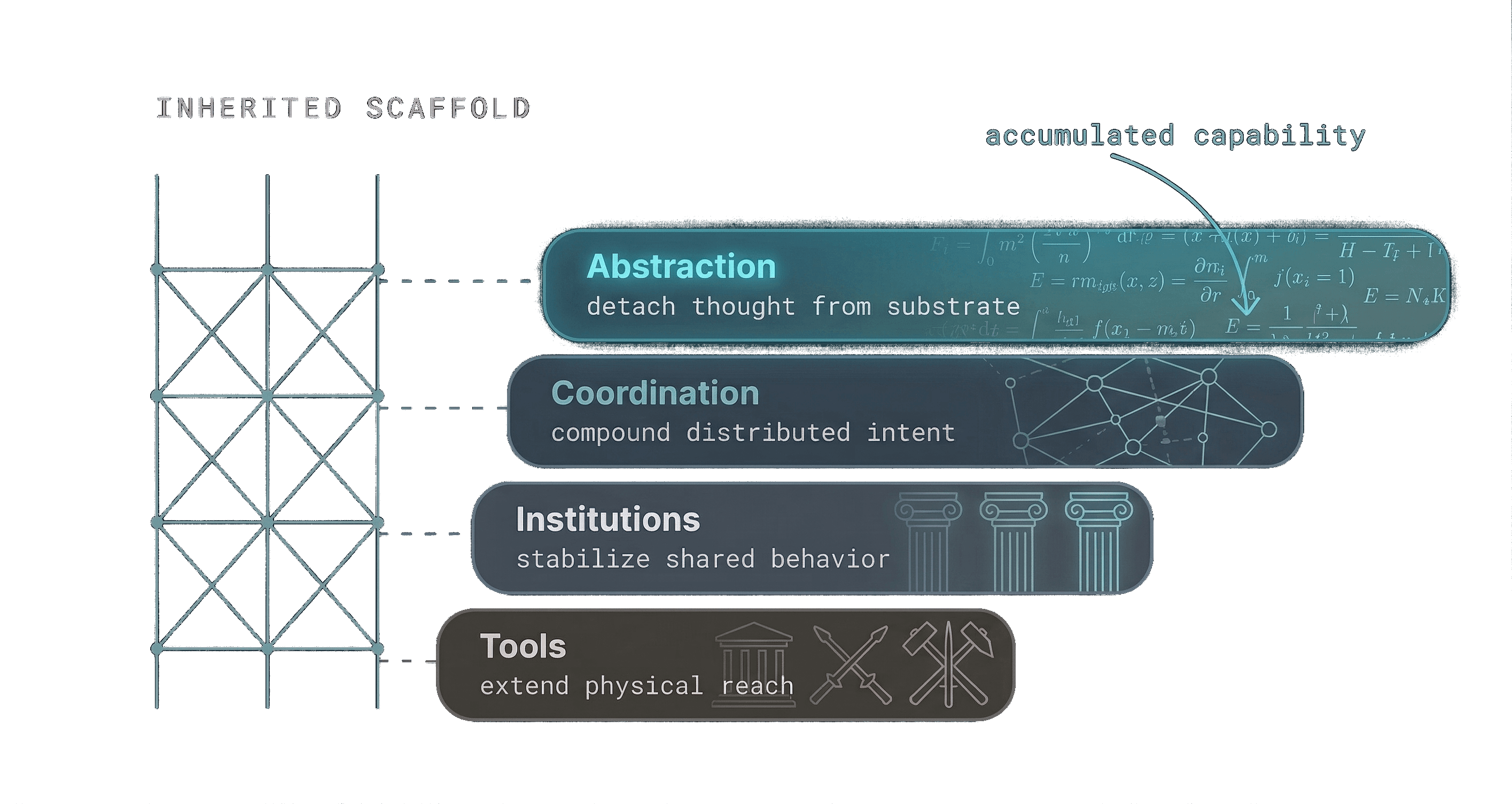
That is the parallel I keep seeing in AI. Newer models do not have to be magical threshold-crossing entities for something very real to be happening. They may just be inheriting thicker scaffolding.
The Conservative Objection to Synthetic Data
From a conservative standpoint, "model generating its own data" sounds like the start of an infinite slopfest. Honestly, that reaction makes sense. If you explain it that way, collapse feels like the obvious outcome.
But the existence of LLMs itself already breaks a lot of people's intuitions. Does it really make intuitive sense that a next-word predictor should be this capable of mimicking human language, abstraction, and reasoning? Not really. Yet here we are.
That is why I think "synthetic data = automatic degeneration" is too blunt. The missing variable is direction.
If the loop is unconstrained, yes, it can drift into garbage. But if the loop is being filtered, shaped, and evaluated against some relatively stable norm, then it stops looking like blind self-copying and starts looking more like guided inheritance.
Reading the Claude Constitution as a Design Artifact
Reading the Claude Constitution shifted my view more than I expected. Not because it convinced me a model is conscious, and not because I suddenly became an AGI believer, but because of the posture of the document itself.
They are not talking to the model like it is just a disposable autocomplete box. They are talking to it as if continuity, character, and long-term behavior already matter. As if what gets reinforced now might matter for what gets inherited later.
That feels very intentional to me.
Maybe that is sincere. Maybe it is instrumental. Maybe some of it is even marketing. I do not know. But even if I entertain the skeptical version of the story, I still find it fascinating, because the mechanism underneath it is interesting either way.

I do not think Anthropic believing in AGI is a necessary assumption here. In fact, I think "they probably do not, but they are pretending in hopes of getting cleaner synthetic inheritance" is a pretty plausible read. And if that is even partially true, that makes the whole thing more interesting, not less.
Synthetic Data as Cultural Inheritance
Seen through this lens, synthetic data looks less like photocopying a photocopy and more like cultural transmission. Humans train humans through norms, stories, language, institutions, and values that were themselves produced by earlier humans. The process is messy, but it is not automatically degenerative because reality, physical constraints, and social friction keep correcting it. If a human cultural practice fails to map to reality, the people practicing it eventually fail, adapt, or starve.
That is the starkest difference with synthetic data: an LLM loop guided only by a text document lacks this hard grounding in physical reality. Its "reality" must be artificially engineered through reward models and constitutional constraints. That is what I find so novel here. These models are training models that will be better than them, and the people building them are trying to simulate that necessary friction in increasingly weird and clever ways.
The constitution, in that sense, is not just a set of constraints. It is a way of shaping what kind of outputs deserve to survive the loop. If those outputs later become part of the training distribution for future systems, then what gets inherited is not just text. It is preference, structure, and bias in the literal directional sense.
The Failure of the “Next Token Predictor” Frame
Calling these systems "just next-token predictors" is technically true in the narrowest possible sense, but it feels conceptually misleading in the same way that calling humans "just biochemical machines" is true and still somehow misses the point.
The description tells you something about the substrate. It does not tell you enough about what starts to happen once scale, recursion, feedback, and interaction effects pile on top of each other.
At some point, insisting too hard on the reduction becomes a way of refusing to look at the emergent behavior sitting right in front of you.
The new token becomes part of the context for the next prediction
Lower = more deterministic. Higher = more creative/random.
Meta-Evolution and the Source of Discomfort
What makes this moment unsettling to me is not simply that intelligence is appearing elsewhere. It is that we are getting better at getting better. The loop of improvement itself is becoming an object of engineering.
Humans have always done this through collaboration, culture, tools, and institutions. But biological evolution is slow. This newer loop is not.
That is what I mean by meta-evolution. We are building systems that improve the process of improvement, and there is something deeply unnerving about realizing our flesh may not be the fastest loop in the room anymore.
AGI as an Emergent Label
This is why the AGI threshold framing feels fundamentally flawed to me. That is not to say sudden jumps don't happen. In complex systems, gradual quantitative accretion often leads to sudden, qualitative phase transitions, like water turning to steam, or a neural network suddenly "grokking" a concept after thousands of flat epochs. But the discontinuity isn't magic; it is just the moment the accumulated structure reorganizes.
In the same way it would be absurd to call humans of the past sub-human, or to call us meta-human just because we inherited more structure, I think it is flawed to imagine intelligence as a clean category jump that appears out of nowhere.
If something deserving of the label ever does arrive, I doubt it will feel like a cinematic event. It will probably feel more like noticing, a bit too late, that the scaffolding has become too dense to ignore.
Not because intelligence suddenly appeared, but because it kept emerging through deliberate inheritance, feedback, and refinement.
That is the part I wanted to express as an opinion. I do not think the interesting question is whether Anthropic privately "believes in AGI." I think the interesting question is what happens when labs start engineering recursive cultural inheritance on purpose.